





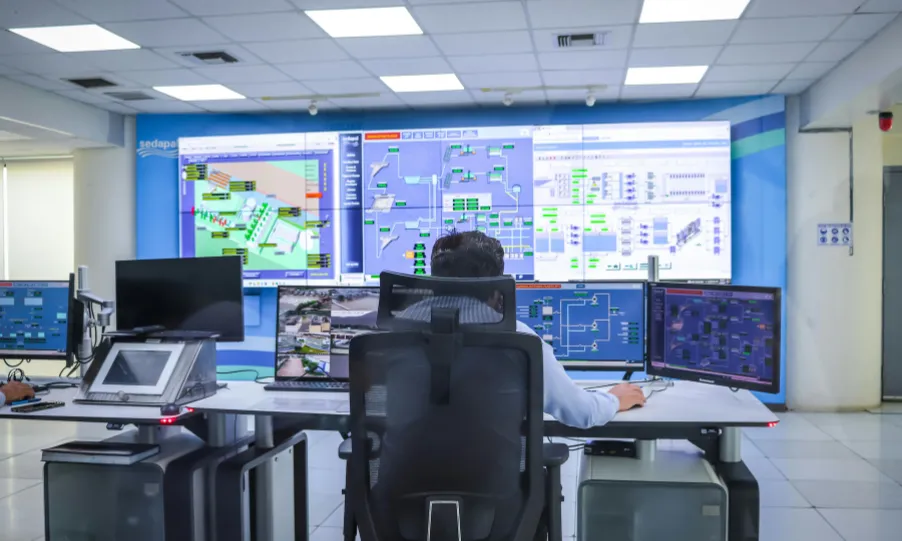
A transport management system (TMS) is software that helps businesses plan, execute, monitor and financially manage the movement of goods. It connects transportation demand with shipments, carriers, vehicles, routes, tracking events, proof of delivery, freight costs and operational reporting.
A modern TMS can support external carriers, private fleets or a combination of both. It typically works alongside ERP, warehouse management, order management, carrier, telematics and accounting systems rather than replacing all of them.
Key takeaways
- A TMS manages much more than GPS tracking; it can support transportation planning through freight settlement.
- Core functions commonly include shipment planning, load consolidation, routing, carrier management, tendering, dispatch, tracking, proof of delivery and freight audit.
- Orders, shipments and loads are different concepts and should not be treated interchangeably.
- TMS software commonly integrates with ERP, WMS, OMS, carrier APIs, EDI, telematics and accounting systems.
- Buying, extending and custom-building a TMS are all valid strategies depending on operating complexity and differentiation.
- Indian transport operations may require additional capabilities such as e-way bill workflows, LR/bilty, fleet/driver processes and local accounting integrations.
- The right TMS should reflect the company’s transportation model rather than simply offer the longest list of features.
What is a transport management system?

A transport management system is a software platform for managing the planning, execution and optimization of freight movement.
SAP describes a transportation management system as software for managing logistics associated with the movement of physical goods across land, air, sea or combinations of modes. Oracle similarly defines TMS around planning, executing and optimizing incoming and outgoing goods movement.
Depending on the business, a TMS may manage:
- customer transportation orders,
- shipments,
- loads,
- routes,
- carriers,
- vehicles,
- drivers,
- freight rates,
- tenders,
- dispatch,
- tracking,
- delivery exceptions,
- proof of delivery,
- invoices,
- settlement,
- transportation analytics.
That makes it different from a simple fleet tracker.
A fleet-tracking application can tell you where a truck is.
A TMS should help answer:
What needs to move? Who should carry it? At what rate? On which route? Has the work been accepted? Is it progressing as planned? Was it delivered? And was the correct amount billed and paid?
Transport management system vs transportation management system
The terms transport management system and transportation management system generally refer to the same software category.
“Transportation management system” is widely used by global enterprise vendors such as SAP and Oracle, while “transport management system” is also common, particularly in markets such as India and the UK.
How does a transport management system work?
A simplified TMS workflow looks like this:
Order
↓
Shipment creation
↓
Load planning and consolidation
↓
Rate/carrier or vehicle selection
↓
Tendering / allocation
↓
Dispatch
↓
Tracking and ETA
↓
Exception management
↓
Proof of delivery
↓
Freight audit
↓
Settlement and analytics
Not every organization uses exactly the same terminology.
However, separating commercial demand from transportation planning and execution is important.
Order
An order represents the underlying business demand.
Examples include:
- customer sales order,
- purchase order,
- stock transfer,
- eCommerce order.
Shipment
A shipment represents freight that needs to move from one location to another under defined transportation requirements.
One order may create several shipments.
Several orders may also contribute freight to the same planned movement.
Load
A load groups freight for physical execution.
For example:
Shipment A + Shipment B + Shipment C → Load 7421
The load might then contain:
- one origin,
- two pickup stops,
- three delivery stops.
Keeping these entities separate becomes increasingly important when transportation operations involve consolidation, partial shipments or multi-stop routes.
Who uses a transport management system?
TMS software can support several operating models.
Shippers
Manufacturers, distributors and retailers use TMS software to plan outbound and inbound transportation, compare carriers and maintain shipment visibility.
3PL providers
Third-party logistics companies may manage transportation for many customers at once, making customer-specific rules, carrier management, visibility and billing important.
Freight forwarders
Forwarders may coordinate multimodal movements involving road, rail, sea and air while also handling documentation and milestones.
Private fleets
Businesses operating their own vehicles may emphasize:
- vehicle assignment,
- driver management,
- capacity,
- route planning,
- fuel,
- telematics,
- proof of delivery.
eCommerce businesses
Their TMS or shipping platform may focus more heavily on:
- order synchronization,
- parcel carriers,
- rate comparison,
- labels,
- customer tracking,
- returns.
Last-mile delivery companies
Typical priorities include:
- driver apps,
- dynamic assignment,
- route sequencing,
- offline workflows,
- delivery proof,
- customer notifications.
For broader examples, Pavans Group’s logistics and transportation software development work covers logistics platforms, delivery systems, TMS-related functionality, fleet technology and integrations.
What are the core modules of a transport management system?
The exact module set varies, but a mature TMS may contain the following.
1. Order and shipment management
Transportation demand can enter through:
- ERP,
- OMS,
- WMS,
- eCommerce systems,
- APIs,
- EDI,
- CSV imports,
- manual entry.
The TMS then creates transportation records containing data such as:
- origin,
- destination,
- requested pickup,
- requested delivery,
- weight,
- dimensions,
- product characteristics,
- service requirement,
- priority.
2. Load planning and consolidation
The system determines which shipments can travel together.
Rules can account for:
- vehicle capacity,
- geographic proximity,
- pickup windows,
- delivery windows,
- equipment type,
- customer priority,
- mode,
- handling requirements.
Consolidation can improve resource utilization, but maximizing consolidation is not always the objective.
A highly consolidated load that misses important delivery windows is not a better plan.
3. Route planning and optimization
A route engine may optimize around:
- distance,
- driving time,
- tolls,
- capacity,
- stop sequence,
- time windows,
- vehicle restrictions,
- driver schedules,
- service duration,
- operating cost.
Route optimization therefore involves considerably more than finding the shortest line between two locations.
4. Carrier management
A TMS can maintain information such as:
- carrier profile,
- transport modes,
- service regions,
- contract information,
- equipment,
- performance,
- capacity,
- rate structures.
This creates a central carrier record rather than requiring operators to work from separate spreadsheets or portals.
5. Rate management and rate shopping
The system may compare transportation choices using:
- contracted rates,
- spot rates,
- fuel surcharges,
- accessorial charges,
- delivery SLA,
- historical carrier performance.
Lowest price should not necessarily win every shipment.
A more realistic rule could be:
cost + service level + available capacity + past performance + customer requirement
6. Tendering
For outsourced transport, the TMS sends the transportation requirement to the selected carrier.
A simple workflow is:
Select carrier → Send tender → Await response → Accept / decline / timeout → Retender if required
7. Dispatch
Once transportation is accepted or assigned, dispatch converts the plan into executable work for:
- carrier,
- vehicle,
- driver,
- internal fleet.
For owned fleets, this can include job sequencing and driver instructions.
8. Real-time tracking
Tracking information may come from:
- carrier APIs,
- EDI,
- GPS,
- telematics,
- driver applications,
- warehouse scans,
- webhooks.
The TMS should normalize these different sources into a consistent operating view.
9. Exception management
Transportation rarely follows the happy path perfectly.
Examples include:
- tender declined,
- pickup missed,
- truck delayed,
- route deviation,
- missing tracking update,
- delivery-window risk,
- failed delivery,
- missing POD,
- invoice mismatch.
The TMS should help operations teams focus on events that actually require intervention.
10. Electronic proof of delivery
POD functionality can capture:
- signature,
- photo,
- recipient,
- timestamp,
- location,
- OTP,
- delivery notes.
A driver or field application can be useful where execution occurs outside the office.
Pavans Group’s mobile app development capabilities are particularly relevant when a logistics platform needs driver or field workflows.
11. Freight audit and settlement
A TMS may compare:
planned rate → actual service → carrier invoice
Potential discrepancies include:
- detention,
- tolls,
- fuel surcharge,
- additional stops,
- weight adjustments,
- re-delivery.
Depending on the business model, the software may manage both carrier payables and customer receivables.
12. Reporting and analytics
Useful TMS metrics can include:
- on-time pickup,
- on-time delivery,
- freight cost per shipment,
- tender acceptance,
- carrier performance,
- load utilization,
- dwell time,
- exception rates,
- invoice variance.
The purpose is not simply to create dashboards.
It is to turn transportation activity into operational decisions.
Transport management system vs WMS, ERP, FMS and OMS
These systems overlap, but their primary responsibilities differ.
| System | Primary responsibility |
|---|---|
| TMS | Transportation planning and execution |
| WMS | Warehouse inventory and fulfilment |
| ERP | Enterprise finance, resources and core business processes |
| OMS | Customer/order lifecycle |
| FMS | Vehicle and fleet operations |
| Last-mile platform | Final-mile dispatch and delivery execution |
TMS vs WMS
A WMS manages what happens primarily inside the warehouse.
A TMS manages how goods travel between locations.
Example:
WMS: picking completed
↓
TMS: shipment ready for planning
↓
Carrier/vehicle selected
↓
Dispatch
↓
Delivery
TMS vs fleet management system
A fleet system typically concentrates on vehicles and drivers.
A TMS can have a broader freight-centric perspective:
What freight must move and what is the best transportation plan?
A private fleet may need both.
TMS vs ERP
An ERP may own:
- customers,
- sales orders,
- procurement,
- accounting,
- invoicing.
The TMS specializes in transportation execution.
SAP describes ERP, WMS and TMS as complementary parts of the end-to-end supply-chain technology environment.
How does a TMS integrate with other software?
Integration is one of the defining characteristics of modern transportation software.
A simplified architecture may look like:
ERP / OMS / eCommerce
↓
Integration/API layer
↓
Transportation data model
↓
TMS
↓
Planning / rating / tender / dispatch
↓
Carriers / fleet / driver applications
↓
Tracking / exceptions / POD
↓
Finance / analytics / customer visibility
ERP integration
Typical information exchanged:
- orders,
- customers,
- suppliers,
- addresses,
- invoices,
- costs.
WMS integration
Typical information:
- order fulfilment status,
- packed quantity,
- warehouse readiness,
- dock activity.
Carrier APIs
A carrier API may provide:
- rates,
- service availability,
- booking,
- labels,
- tracking,
- cancellation.
EDI
Traditional EDI continues to play an important role in many enterprise transportation networks, particularly where trading partners already depend on established message standards.
GPS and telematics
Owned fleets may ingest:
- vehicle location,
- speed,
- geofences,
- mileage,
- ignition state,
- temperature,
- driver behaviour.
Where TMS workflows depend on physical connected devices, Pavans Group’s IoT development services are a natural supporting capability.
What is a cloud-based TMS?
A cloud TMS is hosted and delivered through cloud infrastructure rather than installed only on the customer’s own local servers.
Cloud delivery can make it easier to support:
- remote users,
- multiple locations,
- centralized updates,
- external integrations,
- customer portals,
- scalable infrastructure.
Oracle notes that standalone TMS products may integrate with existing cloud or on-premises ERP and supply-chain systems, while cloud delivery has broadened access beyond only very large transportation organizations.
However, “cloud-based” does not automatically make one system better than another.
Buyers should still evaluate:
- data ownership,
- uptime requirements,
- integration options,
- backup and recovery,
- security,
- export capability,
- vendor dependency.
Transport management systems in India
The core TMS model remains similar globally, but Indian road-transport operations can introduce additional requirements.
Depending on the business, these may include:
- LR/bilty workflows,
- e-way bill generation,
- GST-related processes,
- driver advances and settlements,
- own-fleet operations,
- GPS integration,
- toll/FASTag reconciliation,
- local accounting software,
- transporter and vehicle documentation.
Current Indian TMS products reflect many of these requirements, frequently combining transportation management with fleet operations, documentation and accounting.
E-way bill integration
This is an especially relevant example of India-specific integration.
The official GST e-way bill system provides APIs specifically designed for communication between taxpayer or transporter software and the e-way bill platform.
The documentation covers operations including:
- authentication,
- e-way bill generation,
- consolidated e-way bill generation,
- vehicle updates,
- cancellation,
- rejection,
- validity extension.
The GST documentation explicitly describes API integration as a mechanism for computerized taxpayer or transporter systems to generate e-way bills without duplicate data entry.
For an Indian transport operation generating a high volume of documentation, that can make e-way bill integration an important TMS requirement rather than a separate manual workflow.
What are the benefits of a transport management system?
Avoid evaluating benefits through unsupported percentage claims.
A more useful approach is to connect functionality to operational mechanisms.
| TMS capability | Potential operational effect |
|---|---|
| Shipment consolidation | Better use of available capacity |
| Route optimization | More efficient route selection |
| Rate shopping | Easier carrier and rate comparison |
| Automated tendering | Less manual carrier coordination |
| Real-time tracking | Better transportation visibility |
| Exception management | Faster attention to operational problems |
| ePOD | Faster delivery confirmation |
| Freight audit | Better control over carrier invoices |
| Carrier scorecards | More informed sourcing decisions |
| Central reporting | Consistent transportation data |
Actual business impact depends on the starting process, shipment profile, carrier network and quality of implementation.
Should you buy, extend or build a TMS?
There is no universally correct answer.
Buy a packaged TMS when
A commercial platform is usually the most practical option when:
- workflows are largely standard,
- go-live speed matters,
- existing integrations cover your ecosystem,
- customization needs are limited,
- maintaining proprietary software is not strategically valuable.
Configure or extend an existing TMS when
This can be the best middle ground when:
- most of the core software works,
- you need custom integrations,
- specialized workflows are missing,
- a custom customer portal is required,
- an existing product needs additional automation.
Build a custom TMS when
Custom development becomes more defensible when:
- transportation logic is proprietary,
- routing or rating rules create competitive advantage,
- integrations are unusually complex,
- business workflows do not fit commercial platforms,
- the TMS is part of a larger proprietary logistics product,
- software ownership itself has strategic value.
The decision should not be based only on licence fees.
Compare:
implementation + integrations + customization + infrastructure + maintenance + internal ownership + future change
Pavans Group’s existing technical guide on how to build a transportation management system goes deeper into architecture, data models, integration reliability, event processing and development decisions.
What does a modern TMS architecture look like?
At a high level:
ERP / OMS / eCommerce / WMS
              ↓
      API / integration layer
              ↓
   Canonical transport model
              ↓
             TMS
      ┌───────┼─────────┐
   Planning  Rating   Dispatch
      │         │         │
      └───────┬─┴─────────┘
              ↓
      Carrier / fleet layer
      API / EDI / telematics
              ↓
        Event processing
              ↓
 Tracking / exceptions / POD
              ↓
 Finance / portal / analytics
One particularly useful design principle is to normalize partner data internally.
Suppose carriers report the same shipment state differently:
OUT_FOR_DELIVERYOFDVEHICLE_LEFT_DEPOT
The TMS can translate all three into one internal state.
This prevents every dashboard, notification and reporting module from having to understand each carrier’s terminology.
Do you need microservices for a TMS?
No.
A modular monolith may be entirely appropriate when:
- one engineering team owns the platform,
- traffic levels are manageable,
- business boundaries are still changing,
- independent service deployment is unnecessary.
Separate services become more useful when specific domains have genuinely different scaling or availability requirements—for example, very high-volume telematics ingestion or computationally intensive optimization.
Architecture should follow operational requirements.
It should not follow fashion.
How should a TMS handle real-time transportation events?
Modern TMS platforms may receive thousands or millions of events from:
- carriers,
- drivers,
- vehicles,
- warehouses,
- customers,
- connected devices.
A common event-processing flow is:
Event received
↓
Validate
↓
Detect duplicate
↓
Normalize
↓
Associate with shipment/load
↓
Update status
↓
Evaluate exception
↓
Trigger notification / downstream action
This is particularly important when webhooks, telematics and asynchronous integrations are involved.
How do you implement a transport management system?
A practical implementation usually follows these stages.
1. Map the existing transportation process
Document:
- orders,
- planners,
- dispatchers,
- drivers,
- carriers,
- systems,
- spreadsheets,
- approvals,
- exceptions.
2. Define system boundaries
Determine which system owns:
- customer/order data,
- inventory,
- shipment,
- vehicle,
- financial data.
Do not allow ERP, WMS and TMS to independently become sources of truth for the same data without governance.
3. Prioritize operating problems
Examples:
- manual rate comparison,
- repeated order entry,
- poor tracking,
- inefficient loads,
- missing POD,
- invoice reconciliation.
4. Define integrations
Identify:
- ERP,
- WMS,
- OMS,
- carriers,
- GPS,
- e-way bill,
- accounting,
- customer systems.
5. Configure or build
Implement the selected TMS approach based on actual priority.
6. Test complete workflows
Do not test only successful shipments.
Include scenarios such as:
- carrier decline,
- delayed pickup,
- duplicate event,
- poor network connection,
- failed delivery,
- missing POD,
- incorrect invoice.
7. Pilot
Deploy with a controlled subset of:
- customers,
- depots,
- carriers,
- lanes,
- vehicles.
8. Measure and expand
Use actual operational evidence to decide what should be added next.
How much does a transport management system cost?
There is no useful universal TMS price because commercial products use different pricing models and custom systems vary substantially in scope.
Packaged TMS costs can include
- subscription or licence,
- users,
- vehicles,
- shipment volume,
- implementation,
- integrations,
- onboarding,
- support,
- add-on modules.
Custom TMS cost is driven by
- number of modules,
- user roles,
- carrier integrations,
- ERP/WMS connections,
- route-planning complexity,
- shipment volume,
- mobile applications,
- telematics,
- customer portal,
- e-way bill or compliance integrations,
- data migration,
- analytics,
- security,
- QA,
- infrastructure,
- long-term support.
A simple pricing table without those assumptions can be misleading.
The appropriate approach is to define requirements first and estimate from the actual scope.
How do you choose a transport management system?
Begin with workflows, not software demos.
Evaluate these areas:
Operating model
Do you manage:
- private fleet,
- carriers,
- parcel networks,
- freight forwarding,
- multimodal transportation?
Modes
Does the software support the transportation modes you actually use?
Planning requirements
Do you need:
- simple shipment creation,
- consolidation,
- multi-stop planning,
- constraint optimization?
Carrier ecosystem
How many carriers must be supported?
Which offer:
- APIs,
- EDI,
- neither?
Integration
Can it work with your:
- ERP,
- WMS,
- OMS,
- accounting,
- telematics?
Field execution
Do drivers need:
- mobile jobs,
- offline operation,
- navigation,
- POD,
- payment collection?
Visibility
Who needs tracking?
- operations,
- customers,
- suppliers,
- management?
Financial requirements
Do you need:
- carrier rate management,
- customer freight billing,
- audit,
- settlement?
India-specific requirements
Where applicable:
- e-way bill,
- LR/bilty,
- GST workflows,
- fleet/driver settlements,
- local accounting integrations.
Data ownership
Can you retrieve your complete:
- shipment history,
- rates,
- events,
- financial records?
Extensibility
Can new carriers and integrations be added without replacing the entire platform?
Transport management system examples from Pavans Group’s logistics work
Pavans Group has worked on logistics platforms that demonstrate several of the capabilities discussed in this guide.
Evership: multi-carrier shipping and fulfilment
Evership is a shipping and fulfilment automation platform with order synchronization, multi-carrier rate comparison, shipment creation, labels, driver management, tracking, route-related functionality, APIs and webhooks.
The important TMS lesson is carrier normalization.
Users should not have to understand how every courier structures:
- rates,
- booking,
- labels,
- tracking.
A unified platform can hide those carrier differences behind one workflow.
Molo: last-mile execution with offline capability
Molo combines a mobile delivery application and operational web portal, including parcel tracking, route functionality, proof of delivery and offline operation in poor-connectivity environments.
The lesson here is different:
transportation does not happen inside a perfect office network.
Field execution has to account for real device, connectivity and synchronization constraints.
These projects should not be presented as evidence that every TMS requires identical functionality. They illustrate specific problems that transportation software may need to solve.
What role can AI play in a transport management system?
AI can add value where the organization has enough reliable data and a clear decision problem.
Potential applications include:
- ETA prediction,
- anomaly identification,
- route recommendations,
- carrier selection assistance,
- demand forecasting,
- automated document processing,
- exception prioritization.
But AI should not be treated as a prerequisite for modern TMS software.
Before introducing advanced models, establish good underlying:
- shipment data,
- event history,
- carrier data,
- rate data,
- exception classifications.
Poor transportation data will limit sophisticated automation regardless of the model used.
What should companies avoid when implementing a TMS?
Several mistakes recur.
Buying features rather than solving workflows
A long module list does not guarantee operational fit.
Treating GPS tracking as the entire TMS
Location is valuable, but transportation management extends from planning to financial completion.
Ignoring integration complexity
The success of the system may depend more on ERP and carrier integration quality than on dashboard design.
Automating a broken process
Digitizing unnecessary approvals does not make them useful.
Neglecting exception workflows
The system should be designed for missed pickups, rejected tenders and other real-world deviations.
Adding excessive customization
If a commercial TMS already supports the process well, changing every screen and workflow to mimic the old system can undermine the advantages of using a standard platform.
Building without defining data ownership
ERP, WMS and TMS must have clear responsibilities.
Frequently asked questions
What is a transport management system?
A transport management system (TMS) is software for planning, executing, monitoring and financially managing the movement of goods. It commonly manages shipments, routes, carriers, dispatch, tracking, proof of delivery, freight costs and reporting.
What does TMS mean in logistics?
TMS stands for transportation management system or transport management system. In logistics, it refers to the technology layer primarily responsible for transportation planning and execution.
What are the main features of a TMS?
Common capabilities include order/shipment management, load planning, route optimization, carrier management, rate shopping, tendering, dispatch, live tracking, exception management, ePOD, freight audit and analytics.
What is the difference between a TMS and WMS?
A warehouse management system primarily controls inventory and activities inside a warehouse. A TMS primarily controls transportation between locations. They frequently integrate so fulfilled warehouse orders can become transportation shipments.
What is the difference between TMS and fleet management software?
Fleet management software primarily manages vehicles and drivers. TMS software focuses more broadly on freight planning and transportation execution and may use external carriers as well as private fleets.
Can a TMS manage owned vehicles and external carriers?
Yes. Some transportation-management systems can support private fleets, contracted carriers or hybrid operating models, although capabilities vary by product.
How does a TMS integrate with ERP?
The ERP may send orders, customers and financial information to the TMS. The TMS can return shipment status, transportation costs, POD and settlement data depending on the integration design.
Does a TMS support e-way bills in India?
Some Indian TMS implementations can integrate e-way bill workflows. The official e-way bill platform provides APIs for computerized taxpayer and transporter systems, including generation, updates, cancellation and other operations.
What is a cloud-based transport management system?
A cloud TMS is deployed using cloud infrastructure and normally accessed through web or mobile interfaces rather than relying only on locally installed software. Cloud deployment can make multi-location access and integration easier, but buyers should still assess security, data ownership and reliability.
How much does TMS software cost?
Cost varies according to whether the organization buys, configures or builds the platform. Commercial systems may charge by licence, user, vehicle, transaction or shipment volume, while custom development depends heavily on modules, integrations, routing complexity, scale and support.
Should a company build or buy a TMS?
Buy when workflows are standard and available products meet the requirements. Extend an existing product when the core platform fits but integrations or specialist workflows are missing. Build when proprietary transportation logic or product differentiation makes software ownership strategically valuable.
Can AI be used in transportation management systems?
Yes. AI can support ETA prediction, anomaly detection, route recommendations, forecasting and other decision-support tasks. Its usefulness depends heavily on the quality and quantity of underlying transportation data.
Conclusion
A transport management system sits at the centre of transportation operations by connecting the demand to move goods with the planning, execution and financial processes required to complete that movement.
The most useful way to think about TMS is not as one large feature list, but as a connected lifecycle:
Order → Shipment → Planning → Load → Carrier/vehicle → Tender → Dispatch → Tracking → Exception → Delivery → Settlement
Different businesses need different portions of that lifecycle.
A manufacturer managing contracted carriers has different requirements from a courier network operating its own vehicles. A 3PL serving dozens of customers has different requirements from an eCommerce retailer mainly comparing parcel carriers.
That is why TMS selection should begin with the operating model and current transportation problems—not with a software demo.
For standard workflows, a packaged cloud TMS may be the most efficient choice. Where the core product fits but some workflows do not, configuration and integration may be sufficient. Custom development becomes more appropriate when transportation logic, integrations or customer experience form part of the company’s competitive advantage.
Businesses exploring custom transportation technology can review Pavans Group’s logistics and transportation software development capabilities, while technical teams evaluating architecture can continue to the detailed guide on how to build a transportation management system.
Author bio
Pavans Group Team
Pavans Group is a software and digital product development company based in Vadodara, Gujarat, India. Its web work includes business websites, eCommerce experiences, CMS implementations, web applications, APIs and connected digital platforms, supported by UI/UX design, development, QA, deployment and ongoing maintenance.