






When learning how to choose a web development company in India, start with one question: can the company deliver a website that achieves your business objectives while remaining usable, measurable, maintainable, and fully under your control after launch?
Do not judge agencies only by attractive portfolio screenshots, programming-language logos or the lowest quotation. Evaluate the live work, technical foundations, CMS, search readiness, QA process, ownership model, migration plan and support responsibilities behind the proposal.
The right partner for a five-page corporate website may be completely different from the right partner for an eCommerce store, customer portal or complex web application.
Key takeaways
| What to evaluate | Why it matters |
|---|---|
| Relevant live websites | Screenshots cannot demonstrate real usability or functionality |
| Website objective | The technical solution should follow the business requirement |
| Platform choice | WordPress, Shopify, headless CMS and custom development solve different problems |
| Mobile experience | Google uses mobile content for indexing, and users expect mobile usability |
| Technical SEO | A redesign can damage organic visibility if crawl/indexation and redirects are mishandled |
| CMS usability | Your team should be able to operate the site after launch |
| Performance | Real user experience matters more than an isolated speed score |
| Accessibility | Websites should work for a broad range of users |
| Security | Requirements should reflect the site’s functionality and risk |
| Ownership | Domain, hosting, code and key accounts should have clear control arrangements |
| QA | Forms, payments, browsers, devices and tracking need explicit testing |
| Migration | Existing rankings, URLs and analytics can be lost during careless redesigns |
| Support | Warranty, maintenance and future development are different services |
First decide what kind of website you actually need
A useful vendor comparison starts by categorizing the project correctly.
A corporate or marketing website primarily communicates services, expertise and proof and generates enquiries.
An eCommerce website introduces products, inventory, checkout, payments, shipping, taxation and order management.
A content-heavy website may place more emphasis on publishing workflows, taxonomy, editorial permissions and organic search.
A customer portal can require authentication, dashboards, integrations and business logic.
A web application or SaaS platform may actually be a software-development project rather than conventional website development.
This distinction matters because a company with an excellent portfolio of marketing websites may not be the right engineering partner for a complex multi-tenant web application.
If the project is predominantly custom software rather than a website, use the broader Pavans Group guide on choosing a software development company in India instead.
Start with the outcome, not the technology
Avoid beginning the conversation with:
“We need a WordPress website.”
or:
“We want Next.js.”
Start with what the website must accomplish.
For example:
“We are a B2B manufacturer. We need buyers from India and overseas markets to understand our capabilities, find industry-specific solutions and submit qualified enquiries.”
That requirement creates better questions.
How should the site architecture organize products and industries? Which information does a technical buyer need before contacting sales? How should enquiry tracking work? Does the marketing team need to publish landing pages without developers? Which pages need to support organic search?
The technology decision comes later.
An agency that recommends its preferred platform before understanding the commercial and operational requirements may be fitting your business into its workflow rather than designing the website around yours.
Inspect live work like a customer
Portfolio screenshots are useful for understanding visual style, but they are weak evidence of a working website.
Open relevant client projects yourself.
Use a phone as well as a desktop. Navigate from the homepage to an important conversion page. Submit a form if appropriate. Examine navigation, content hierarchy, error states, images, search, checkout and other relevant interactions.
Then ask the agency what it actually delivered.
Was it responsible for strategy, UI/UX, frontend development, backend development, CMS configuration, content migration and deployment?
Or did it only redesign the interface?
The difference matters.
Match projects by problem, not just industry
Industry experience can shorten discovery, but technical and user-journey similarity can be equally important.
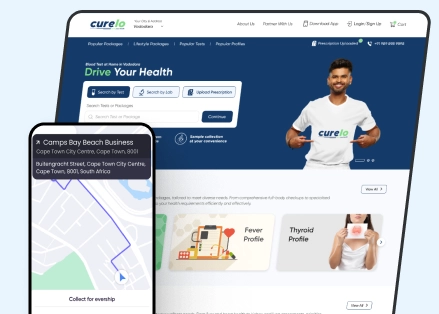
For example, Pavans Group’s Curelo case study documents a web-based diagnostic booking platform with test discovery, pricing, online payments, booking workflows and connected operational systems. That provides more useful evidence for evaluating complex transactional web capability than a static healthcare brochure site would.
Similarly, the Evership project demonstrates a web platform involving order synchronization, carrier integrations, rate comparison, webhooks, tracking and operational dashboards.
The useful question is not merely, “Have you worked in our industry?”
Ask:
“Have you solved a comparable web, content, transaction or integration problem?”
Ask the agency to justify the platform
A trustworthy web company should be able to explain why the proposed technology is appropriate.
WordPress may make sense when content editing, publishing and a large plugin ecosystem are priorities.
Shopify can make sense when the business needs a mature hosted commerce platform.
A headless CMS may be valuable when content must feed multiple frontends or when development and editorial requirements justify the additional architecture.
Custom React, Next.js, Laravel, Node.js or other application development can make sense when the project contains functionality that a conventional CMS or commerce platform cannot represent cleanly.
None of these is automatically “more modern” or “better.”
Ask what the choice means for:
editing → hosting → security → integrations → ongoing maintenance → developer availability → recurring licences → future migration
The agency should be able to discuss those trade-offs without turning the conversation into a framework sales pitch.
Pavans Group’s own web development service page lists WordPress/headless CMS, Shopify/WooCommerce/Magento and custom application technologies among its capabilities. That breadth is useful only if the chosen stack follows the requirements rather than being prescribed in advance.
Test the CMS before you approve the proposal
This is an area many vendor-selection guides miss.
The website is not truly maintainable simply because it “has a CMS.”
Ask for a demonstration of how your marketing or operations team would perform common tasks.
Could a non-developer publish a new service page?
Could they change a title and meta description?
Could they update navigation?
Could they replace a hero image without breaking the layout?
Could they create redirects when URLs change?
Could they reuse approved page components without calling the development company?
Could different users receive appropriate permissions?
A CMS that technically permits editing but requires developers for routine business changes can create a hidden operating cost.
Define these editorial tasks before development so they influence the content model and administration experience.
Evaluate technical SEO before the website is built
“SEO-friendly website” is too vague to belong in a proposal.
Ask the agency what that phrase means.
A reasonable technical foundation should account for page structure, crawlable navigation, metadata management, indexation controls, canonical URLs, XML sitemaps, redirects, semantic headings, image handling and structured data where it accurately represents visible content.
The development team does not need to provide ongoing SEO strategy unless that is part of the agreement.
It does need to avoid building unnecessary technical barriers for the people responsible for SEO later.
Google also uses the mobile version of a site’s content for indexing and ranking and recommends responsive web design as the easiest mobile configuration to implement and maintain.
That means mobile development is not a decorative final-stage task.
Ask the team how it ensures content, metadata, internal links and important functionality remain available on mobile.
Do not choose an agency using a PageSpeed score alone
Running prospective portfolio sites through performance tools can reveal useful questions.
It should not become an automatic pass/fail score for the agency.
A PageSpeed result can vary with the page, test conditions, third-party scripts, advertisements, analytics, hosting and changes made by the client after handover.
Instead, ask how the team approaches actual user experience.
Google recommends good Core Web Vitals, secure delivery and strong mobile usability, but its own guidance explicitly says site owners should consider page experience holistically rather than focus on one or two isolated metrics.
A better agency conversation is:
“How will you measure and improve performance on our important page types, and what factors could remain outside your control?”
That question reveals considerably more than asking for a guaranteed Lighthouse number.
Include accessibility in the quality discussion
Accessibility is easy to omit because problems are not always obvious in a visual design review.
Ask whether the development process considers:
- keyboard interaction,
- semantic structure,
- form labels and validation,
- text contrast,
- focus behaviour,
- meaningful alternative text,
- interactive target size,
- accessible authentication where relevant.
W3C’s WCAG 2.2 is the current international web-content accessibility standard and covers accessibility across desktop and mobile web content.
The level of formal conformance your organization needs depends on its context and requirements, but an agency should at minimum be able to discuss accessibility intelligently rather than treat it as an optional plugin.
For a redesign, investigate migration expertise
A new website and a website redesign carry different risks.
If the existing site receives organic traffic, has external links or has been indexed for years, the old URL structure has value.
Ask the agency for a migration plan before development finishes.
A sensible plan should determine which existing URLs remain, which URLs change, where redirects are required and how important metadata and content will be transferred.
It should also address staging.
A development environment should not accidentally compete with the live site in Google, and the production site should not accidentally inherit noindex controls when launched.
Before and immediately after release, confirm:
old URL → new URL mapping → redirects → canonicals → sitemap → robots/indexation → analytics → Search Console → important conversion tracking
This is one of the clearest differences between merely building pages and responsibly replacing a live business website.
Ask what happens to analytics during the rebuild
A visually successful redesign can still damage business intelligence if measurement is forgotten.
Before launch, document the conversions that matter.
For a B2B website that might include:
form submission → call click → email click → quotation request → file download → booked meeting
For eCommerce, the measurement plan may need to cover:
product view → cart → checkout → purchase
Ask who is responsible for implementing analytics and who validates events after launch.
Just as importantly, clarify account ownership.
Google Analytics, Search Console, Tag Manager and advertising integrations should not disappear with an agency employee or remain accessible only through an external vendor’s personal account.
Make website ownership explicit
One of the best pre-contract questions is:
“If we stop working together six months after launch, what exactly can we take with us?”
The answer should cover much more than source code.
Use a handover matrix like this:
| Asset | Confirm before signing |
|---|---|
| Domain | Registered under appropriate client control |
| DNS | Client has administrative access |
| Hosting/cloud | Ownership and billing arrangement documented |
| Source repository | Access and ownership defined |
| CMS | Client administrator access |
| Database | Export and access process defined |
| UI/UX files | Handover terms defined |
| Analytics | Client-controlled property/account access |
| Search Console | Client ownership/access |
| Tag Manager | Client ownership/access |
| Email/form services | Access and billing documented |
| Premium plugins/themes | Licence ownership and renewal costs |
| Fonts/images | Usage rights documented |
| Backups | Location and restoration process |
| Documentation | Included deliverables defined |
The correct legal ownership structure depends on the agreement and any pre-existing or third-party components, so contractual language should receive appropriate legal review.
But ambiguity is avoidable.
Evaluate security according to the website’s risk
A five-page informational website and a customer portal holding sensitive data should not have identical security requirements.
At minimum, ask how the agency handles secure deployment, software updates, credentials, backups and form/input handling.
For web applications involving authentication, sensitive records, APIs or payments, security requirements need to become more formal.
The OWASP Application Security Verification Standard provides a framework for testing web-application security controls and can also be used to specify security-verification requirements during procurement.
The most revealing question is not:
“Is the website secure?”
Ask:
“What security requirements does this project actually have, how will you implement them, and how will they be verified?”
Ask for a real QA and acceptance plan
“Testing included” is another phrase that needs definition.
Before approving the proposal, agree on what will constitute an acceptable release.
For a typical business website, acceptance testing may include mobile layouts, major browsers, links, forms, email delivery, navigation, CMS workflows, redirects, analytics events, cookie/consent behaviour where applicable and important performance checks.
For eCommerce, add product variations, inventory behaviour, coupons, payment success/failure, taxes, shipping, transactional email, refunds and order-status workflows as appropriate.
For portals, add permissions, authentication, file uploads, API failures and workflow-specific edge cases.
The objective is not to create an enormous test document for a simple website.
It is to make “the website is complete” measurable before final payment.
Compare quotations by deliverable, not headline total
Suppose one company quotes ₹80,000 and another quotes ₹1.5 lakh.
Those numbers mean little until the scopes are aligned.
One quotation may include custom UI/UX, CMS configuration, content migration, technical SEO, QA, analytics and support.
The other may include a theme installation, page setup and deployment.
Neither is automatically wrong.
They are simply different products.
For detailed pricing research, use the separate Pavans Group guide to website development cost in Vadodara. That article owns the budgeting intent and explains why similar-looking website quotations can represent substantially different scope.
For this selection decision, normalize proposals into:
| Area | Company A | Company B | Company C |
|---|---|---|---|
| Discovery and site architecture | |||
| UI/UX design | |||
| Page templates | |||
| Development | |||
| CMS/editor experience | |||
| eCommerce/functionality | |||
| Integrations | |||
| Content entry/migration | |||
| Technical SEO setup | |||
| Redirect migration | |||
| Analytics/tracking | |||
| Accessibility scope | |||
| QA | |||
| Hosting/deployment | |||
| Documentation | |||
| Warranty | |||
| Maintenance | |||
| Recurring licences | |||
| Explicit exclusions |
Only after completing this exercise does price become meaningfully comparable.
Separate defects, maintenance and enhancements
Ask the agency to define these three categories.
A defect means functionality agreed in the scope does not work as accepted.
Maintenance may cover areas such as backups, platform updates, monitoring and routine technical upkeep.
An enhancement changes or expands the website—for example, adding another integration, a new calculator or a different customer journey.
If the contract simply says “support included,” neither side knows what that means.
Define the support period, contact route, priority levels where necessary and how future work will be estimated.
Verify the Indian company behind the proposal
For a meaningful commercial project, verify who you are actually contracting with.
India’s Ministry of Corporate Affairs provides public company/LLP master-data services, which can be used to inspect registered entity information.
GST information can also be checked through the official taxpayer-search function; GST guidance specifically directs users to verify GSTINs using Search Taxpayer → Search by GSTIN/UIN.
Compare the relevant information across:
proposal → agreement → invoice → legal entity → GST details → bank beneficiary
This does not prove that a company is technically good.
It verifies that you understand which organization you are paying.
Local agency or remote Indian development company?
Distance is a business constraint, not a quality metric.
A nearby company may be useful when the project involves frequent onsite discovery, photography, stakeholder workshops or a strong local-business component.
A remote company can work equally well when it provides structured communication, staging access, written approvals, predictable review cycles and appropriate working-hours overlap.
For businesses specifically looking locally, Pavans Group already has a separate comparison article for Top Web Development Companies in Vadodara, so this national guide should not attempt to rank local providers.
Evaluate local and remote candidates with the same acceptance criteria.
What a good proposal should tell you
A good proposal should make uncertainty smaller.
After reading it, you should understand what is being built, what is not being built, what you need to provide, which assumptions affect the schedule, how reviews work, what accounts or licences are required, when payments become due and what happens after launch.
Be cautious of proposals built mainly around package labels such as:
Silver website
Premium business package
Enterprise website
unless the underlying deliverables are defined.
The package name has no technical meaning.
The scope does.
Red flags worth investigating
A single concern may have an innocent explanation, but several unresolved warning signs should affect your decision.
Be especially cautious when an agency cannot show relevant live work; recommends a platform before understanding the project; guarantees Google rankings; cannot explain CMS ownership; gives no migration plan for an established website; keeps the domain and critical accounts exclusively under its control; provides no explicit exclusions; treats security, accessibility or QA as vague assurances; has no process for changes; or cannot explain what happens when the relationship ends.
Google itself recommends looking at page experience holistically, which is one reason claims such as “we guarantee ranking because we build fast websites” should be treated skeptically.
Questions to ask a web development company before hiring
Use the same questions with every serious finalist:
- What do you believe this website needs to accomplish for our business?
- Which live projects have the most similar user journey or technical complexity?
- What exactly did your team deliver on those projects?
- Which platform would you recommend for us, and why?
- How will our internal team update pages and content after launch?
- What technical SEO work is included in development?
- If this is a redesign, how will you protect existing URLs and organic visibility?
- How will mobile, browser, forms and other important journeys be tested?
- What accessibility requirements are included?
- What security requirements apply to this website?
- Who owns the domain, DNS, hosting, repository, CMS and analytics accounts?
- Which recurring licences or platform fees should we expect?
- What exactly is excluded from your proposal?
- What constitutes a defect after launch, and how long is it covered?
- If another company takes over next year, what documentation and assets will we receive?
You do not need every provider to give identical answers.
You need answers that are specific enough to evaluate.
A better final decision framework: fit, proof, control and continuity
Rather than trying to identify a universally “best” agency, make the final decision through four gates.
Fit
Does the provider understand this specific type of website, audience and business outcome?
Proof
Can it demonstrate relevant live work and explain the decisions behind it?
Control
Will your business retain appropriate control over content, domain, hosting, code, data and measurement?
Continuity
Can the site be maintained, changed and eventually transferred without unnecessary dependence on one supplier?
A company that passes all four is usually a stronger long-term choice than one selected mainly for price, awards or presentation quality.
Where Pavans Group fits
Pavans Group’s current web development capabilities cover business websites, CMS platforms, eCommerce, progressive web apps and custom web applications, along with UI/UX, API integrations and maintenance.
Its public portfolio also includes different kinds of web work rather than only brochure sites. Curelo combines a public booking experience with payments and operational systems, while Evership is a web-based shipping and fulfilment platform involving order synchronization, carrier integrations, tracking and APIs.
Those projects can be used as evidence during evaluation, but the same framework in this guide should be applied to Pavans Group as to any other candidate.
Review the relevant live or documented work. Ask who will work on your project. Test the proposed CMS and technical approach. Confirm scope, ownership, migration responsibilities, QA and post-launch terms.
The purpose of a buyer’s guide should be to help you make the right choice-even when that means challenging the company that published it.
Frequently asked questions
How do I choose the right web development company in India?
Start by defining the website’s business objective and then evaluate companies through relevant live work, platform reasoning, CMS usability, mobile experience, technical SEO, QA, security, ownership and post-launch support. Give shortlisted companies the same brief so their proposals can be compared on equivalent scope.
What should I check in a web development company’s portfolio?
Visit live websites rather than relying only on screenshots. Test important journeys on mobile and desktop, then ask what the agency actually designed or developed and whether the same team or capability is still available.
Should a web development company also understand SEO?
It should understand the technical foundations that affect crawling, indexing, site architecture, mobile delivery, metadata, redirects and performance. That does not mean the development agency must also provide your ongoing SEO strategy.
Should I choose WordPress, Shopify or custom web development?
Choose according to the website’s requirements. WordPress can work well for content-led sites, Shopify can reduce infrastructure complexity for many eCommerce businesses, and custom development becomes appropriate when workflows or functionality exceed what standard platforms can express efficiently.
How important are Core Web Vitals when choosing an agency?
Performance is important, and Google recommends good Core Web Vitals, but do not evaluate an agency using one lab score alone. Ask how performance will be measured on your key page types and what development, hosting and third-party factors will affect the result.
Who should own the domain and hosting?
The commercial arrangement should be documented clearly, but for business-critical assets the client should normally retain appropriate ownership or administrative control so the website can continue operating if suppliers change.
What should happen to SEO during a website redesign?
Existing URLs, valuable content, metadata and search performance should be reviewed before migration. Changed URLs need appropriate redirects, and indexation, sitemaps, analytics and Search Console should be checked during launch.
How many web-development companies should I compare?
A focused group of roughly three to five credible candidates is generally easier to evaluate deeply than a very large list. The important part is giving them comparable requirements and verifying their evidence consistently.
Should I choose the cheapest web-development quotation?
Not automatically. First compare discovery, design, templates, CMS, functionality, integrations, migration, SEO, testing, licences and support. A lower price may simply contain less scope.
What should be delivered when the website project ends?
The handover should reflect the contract and project, but commonly includes website/CMS access, source code where applicable, relevant design files, documentation, hosting/domain access arrangements, analytics/Search Console access, database/backups and details of third-party licences.
Conclusion
Choosing a web development company in India is ultimately about determining whether the company can deliver a website that works for your users and remains a manageable business asset after launch.
Do not stop at visual design.
Evaluate how the company thinks about:
business goals → user journeys → platform selection → content management → mobile delivery → search foundations → performance → accessibility → security → QA → ownership → maintenance
For an existing website, add one more priority:
migration discipline.
A beautiful redesign is not successful if important URLs disappear, search visibility declines, analytics stops working or your internal team cannot update the new CMS.
The strongest development partner should make these responsibilities clearer before you sign the agreement.
If you are planning a new site, eCommerce experience, portal or web platform, you can review Pavans Group’s web development services and software and web project portfolio, then use the same evaluation framework from this guide when comparing Pavans Group with other candidates.
The goal is not to find the company with the most technologies on its website.
It is to choose a team that can build the right website, hand it over properly and leave you in control of what comes next.
Author bio
Pavans Group Team
Pavans Group is a software and digital product development company based in Vadodara, Gujarat, India. Its web work includes business websites, eCommerce experiences, CMS implementations, web applications, APIs and connected digital platforms, supported by UI/UX design, development, QA, deployment and ongoing maintenance.


