






Custom Software Development for Logistics helps transportation companies, warehouse operators, and supply chain businesses streamline operations through tailored digital solutions. As delivery expectations and supply chain complexity continue to grow, businesses need more than generic software. Custom logistics solutions such as Transportation Management Systems (TMS), Warehouse Management Systems (WMS), Fleet Management Software, and AI-powered Logistics Automation provide real-time visibility, improved efficiency, and better decision-making. Whether you’re looking to optimize transportation, automate warehouse operations, manage fleets, or enhance customer experiences, custom logistics software offers the flexibility and scalability needed to stay competitive. This guide explores the key logistics software solutions, benefits, features, and technologies driving digital transformation across the logistics industry.
What is Custom Software Development for Logistics?
Custom Software Development for Logistics is the process of designing, building, and integrating specialized logistics software tailored to the unique operational requirements of transportation companies, freight operators, warehouses, supply chain businesses, and delivery networks. Unlike off-the-shelf solutions, custom logistics platforms provide greater flexibility, automation, scalability, and competitive advantage through features such as Transportation Management Systems (TMS), Warehouse Management Systems (WMS), fleet tracking, route optimization, and AI-driven logistics automation.
Why Logistics Companies Need Custom Software Today
The logistics industry is undergoing rapid digital transformation.
Global supply chains have become increasingly complex, customer expectations for faster delivery continue to rise, and operational costs are under constant pressure.
Traditional spreadsheets, disconnected software tools, and manual processes are no longer sufficient.
Modern logistics businesses require:
- Real-time shipment visibility
- Automated workflows
- Intelligent route planning
- Warehouse optimization
- Fleet performance monitoring
- Predictive analytics
- Seamless customer communication
This is where custom logistics software becomes a strategic business asset.
Organizations investing in Logistics Software Development gain better control over operations while reducing costs and improving customer satisfaction.
Quick Overview: Key Logistics Software Types
| Software Type | Primary Purpose |
|---|---|
| Transportation Management System (TMS) | Shipment planning and transportation execution |
| Warehouse Management System (WMS) | Warehouse inventory and operations management |
| Fleet Management Software | Vehicle tracking and fleet optimization |
| Freight Management Software | Freight planning and carrier management |
| Supply Chain Software | End-to-end supply chain visibility |
| Logistics ERP Solutions | Integrated business operations |
| Logistics CRM | Customer relationship management |
| Last-Mile Delivery Software | Delivery optimization and tracking |
The Growing Demand for Logistics Technology
According to industry research, logistics technology investments continue to grow as organizations pursue:
- Digital transformation
- Supply chain resilience
- AI adoption
- Predictive logistics
- Warehouse automation
- Real-time visibility
Businesses adopting Logistics Automation Software frequently report:
- Reduced operational costs
- Faster order processing
- Improved fleet utilization
- Better inventory accuracy
- Increased customer retention
For logistics providers competing in global markets, technology is no longer optional—it is a competitive necessity.
Custom Software Development for Logistics: Core Solutions
Transportation Management Software (TMS)
A Transportation Management System helps businesses manage transportation operations from planning to delivery.
Key Features
- Route optimization
- Carrier management
- Freight cost calculation
- Shipment tracking
- Driver management
- Electronic proof of delivery
- Delivery analytics
Business Benefits
- Lower fuel costs
- Improved delivery times
- Better resource utilization
- Reduced transportation expenses
Example Use Case
A regional logistics company handling 10,000 monthly shipments can automate dispatching and route planning, significantly reducing manual effort and delivery delays.
Warehouse Management Software (WMS)
Warehouse Management Software controls inventory movement, storage operations, picking, packing, and shipping.
Key Features
- Inventory tracking
- Barcode scanning
- RFID integration
- Order fulfillment
- Warehouse analytics
- Stock forecasting
Business Benefits
- Increased inventory accuracy
- Faster order processing
- Reduced warehouse errors
- Better inventory visibility
Example Use Case
An eCommerce fulfillment center can automate inventory tracking across multiple warehouses, improving stock accuracy and reducing fulfillment delays.
Fleet Management Software
Fleet Management Solutions enable logistics operators to monitor vehicles, drivers, and transportation performance in real time.
Features
- GPS tracking
- Fuel monitoring
- Driver behavior analysis
- Maintenance scheduling
- Route optimization
- Telematics integration
Benefits
- Reduced fuel consumption
- Improved vehicle utilization
- Lower maintenance costs
- Enhanced driver safety
Custom Fleet Management Software Solutions can be integrated directly with TMS platforms to create a unified logistics ecosystem.
Freight Management Software
Freight operations involve multiple stakeholders including shippers, carriers, brokers, and customers.
Custom Freight Management Software Development helps streamline these processes.
Core Capabilities
- Freight booking
- Carrier selection
- Freight tracking
- Rate management
- Freight billing
- Documentation management
Benefits
- Improved freight visibility
- Better carrier relationships
- Reduced administrative workload
Supply Chain Software Development
Supply chains today extend across multiple countries, suppliers, warehouses, and transportation networks.
Custom Supply Chain Software Solutions provide centralized visibility and control.
Features
- Supplier management
- Demand forecasting
- Inventory planning
- Procurement management
- Supply chain analytics
- Risk monitoring
Business Advantages
- Reduced disruptions
- Better planning accuracy
- Improved supplier collaboration
- Enhanced forecasting
Supply Chain Management Software Development Services help organizations build resilient and scalable supply chains.
Logistics Automation: The Future of Operations
Automation is transforming logistics at every stage.
Areas of Automation
Order Processing
Automatically process incoming orders and assign workflows.
Dispatch Automation
Assign drivers and vehicles based on availability and route optimization.
Inventory Management
Update inventory levels automatically in real time.
Delivery Notifications
Send automated customer updates and tracking information.
Billing Automation
Generate invoices and payment reminders automatically.
Benefits of Logistics Automation Software
- Reduced human errors
- Faster operations
- Improved customer experience
- Lower operating costs
AI-Powered Logistics Software Development
Artificial Intelligence is rapidly becoming a core component of modern logistics platforms.
AI Applications in Logistics
Predictive Route Optimization
Analyze traffic, weather, and historical data to identify optimal routes.
Demand Forecasting
Predict future demand and inventory requirements.
Predictive Maintenance
Identify vehicle maintenance issues before failures occur.
Intelligent Load Planning
Optimize cargo utilization and shipment planning.
Customer Service Automation
AI chatbots provide shipment updates and support.
Organizations investing in AI-Powered Logistics Software Development gain significant operational advantages and scalability.
Last-Mile Delivery Software Development
The last mile is often the most expensive stage of the delivery process.
Custom Last-Mile Delivery Software helps companies improve delivery efficiency.
Features
- Route optimization
- Driver mobile applications
- Real-time tracking
- Electronic proof of delivery
- Delivery analytics
- Customer notifications
Benefits
- Faster deliveries
- Reduced delivery costs
- Improved customer satisfaction
SaaS Logistics Software Development
Many logistics companies now prefer SaaS-based platforms.
Advantages
- Lower upfront investment
- Faster deployment
- Easy scalability
- Subscription-based pricing
- Cloud accessibility
A SaaS Logistics Software Development Company can help organizations launch scalable logistics products for global markets.
Essential Features of a Modern Logistics Platform
A successful Logistics Platform typically includes:
Operations Management
- Shipment management
- Order processing
- Scheduling
Transportation Management
- Route planning
- Fleet management
- Driver tracking
Warehouse Management
- Inventory control
- Picking and packing
- Fulfillment management
Analytics and Reporting
- KPI dashboards
- Predictive analytics
- Business intelligence
Customer Management
- CRM integration
- Customer portals
- Support systems
Security
- Role-based access
- Data encryption
- Compliance management
Custom Software vs Off-the-Shelf Logistics Solutions
| Factor | Custom Logistics Software | Off-the-Shelf Software |
|---|---|---|
| Flexibility | High | Limited |
| Scalability | Excellent | Moderate |
| Integration | Fully customizable | Limited |
| Competitive Advantage | Strong | Low |
| Ownership | Complete | Vendor dependent |
| Long-Term ROI | High | Moderate |
Logistics Software Development Process
1. Discovery & Requirements Analysis
Understand workflows, challenges, and business objectives.
2. Solution Architecture
Design scalable system architecture and integrations.
3. UI/UX Design
Create user-friendly interfaces for operators, managers, and customers.
4. Development
Build web, mobile, cloud, and backend systems.
5. Integration
Connect ERP, CRM, IoT devices, GPS systems, and third-party APIs.
6. Testing
Perform quality assurance and performance testing.
7. Deployment
Launch securely in cloud or on-premise environments.
8. Continuous Support
Provide updates, maintenance, and feature enhancements.
How Much Does Logistics Software Development Cost?
The cost depends on:
- Project complexity
- Number of features
- Integrations required
- Mobile applications
- AI capabilities
- Cloud infrastructure
Typical Estimates
| Project Type | Estimated Cost Range |
|---|---|
| Basic Logistics Platform | $20,000 – $50,000 |
| Mid-Level TMS/WMS | $50,000 – $150,000 |
| Enterprise Logistics Platform | $150,000 – $500,000+ |
| AI-Driven Logistics Ecosystem | $250,000 – $1M+ |
Actual pricing varies based on requirements and technology stack.
Why Choose a Logistics Software Development Company in India?
India has emerged as a global destination for logistics software development due to:
- Highly skilled developers
- Cost efficiency
- Strong engineering talent
- Global delivery experience
- Expertise in AI, cloud, mobile, and enterprise systems
Many global enterprises hire logistics software developers in India to accelerate innovation while optimizing development costs.
Why Businesses Choose Pavans Group for Logistics Software Development
Pavans Group helps startups, logistics providers, transportation companies, and enterprises build scalable digital logistics solutions.
Our expertise includes:
- Transportation Management Systems
- Warehouse Management Systems
- Fleet Management Software
- Logistics ERP Solutions
- AI-powered logistics platforms
- SaaS logistics products
- Mobile logistics applications
- Supply chain software development
With experience delivering web, mobile, AI, IoT, and enterprise solutions, we help organizations modernize logistics operations and accelerate growth.
Case Study: Evership – Transforming Logistics Operations
Pavans Group built Evership, a powerful logistics and parcel management platform designed for courier companies and last-mile delivery providers. The solution combines a centralized shipping dashboard with multi-carrier integrations, real-time shipment tracking, driver management, and branded delivery experiences, enabling businesses to manage their logistics operations from a single platform.
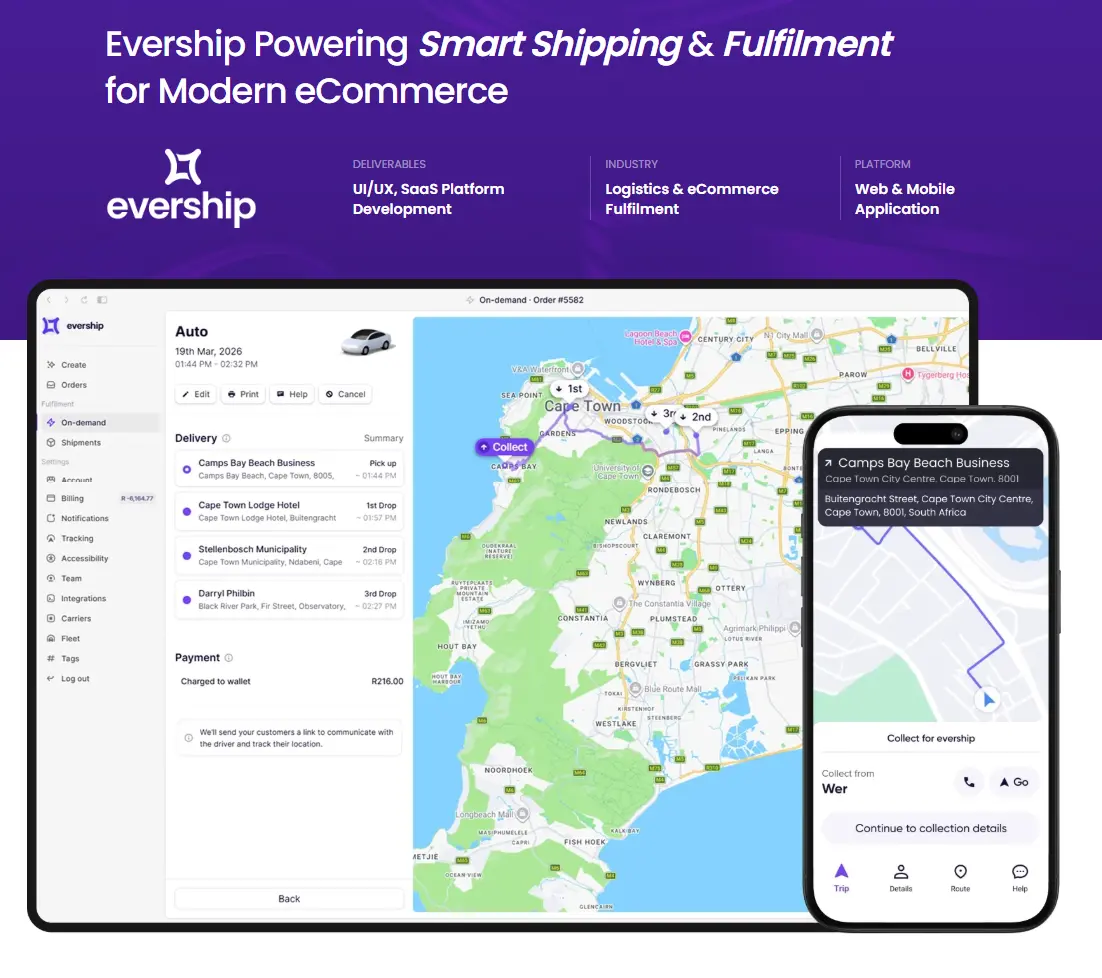
Results: Evership has helped streamline logistics workflows for more than 500 companies and supports over 1,200 registered users. With automated order synchronization from eCommerce platforms such as Shopify, instant shipping label generation, and scalable API integrations, the platform significantly reduces manual effort while improving delivery efficiency and operational visibility.
This project highlights Pavans Group’s expertise in developing custom logistics software, transportation management systems, and fleet management solutions that help businesses optimize supply chain operations and scale with confidence.
FAQ’s
1. What is custom software development for logistics?
It involves creating tailored logistics applications such as Transportation Management Systems (TMS), Warehouse Management Systems (WMS), fleet management software, freight management platforms, and supply chain solutions designed specifically for a company’s operational requirements.
2. How much does logistics software development cost?
Logistics software development costs typically range from $20,000 to $500,000+ depending on project complexity, required integrations, automation features, scalability requirements, and AI capabilities.
3. What is the difference between TMS and WMS?
A Transportation Management System (TMS) manages transportation planning, shipment execution, and carrier operations, while a Warehouse Management System (WMS) focuses on inventory control,
storage optimization, and warehouse fulfillment processes.
4. Can logistics software integrate with ERP systems?
Yes. Modern logistics platforms can seamlessly integrate with ERP systems, CRM software, accounting tools, IoT devices, GPS tracking systems, eCommerce platforms, and third-party APIs to create a unified operational ecosystem.
5. Why choose custom logistics software instead of off-the-shelf solutions?
Custom logistics software provides greater flexibility, scalability, integration capabilities, full ownership, and higher long-term ROI. It can be tailored to specific business processes, unlike generic off-the-shelf solutions that may have functional limitations.
Conclusion
Custom Software Development for Logistics has become a critical investment for transportation companies, freight operators, warehouse providers, supply chain organizations, and delivery businesses.
Whether you need Transportation Management Software, Warehouse Management Software, Fleet Management Solutions, AI-powered automation, or a complete Logistics Platform, custom software provides the flexibility, scalability, and efficiency needed to compete in today’s digital economy.
Businesses that embrace logistics technology today are better positioned to reduce costs, improve visibility, automate operations, and deliver exceptional customer experiences tomorrow.
Ready to Build Your Logistics Software Platform?
Pavans Group helps logistics companies design, develop, and scale custom logistics software solutions tailored to their unique business needs.
Contact our team to discuss your logistics software development requirements and accelerate your digital transformation journey.
Author Bio
Pavans Group Team
Pavans Group is a top-rated software, web, mobile app, AI and IoT development company based in Vadodara, Gujarat. With 100+ apps delivered for clients including Amul, Indian Oil, and global startups, we help businesses build reliable, scalable digital products. Rated 4.9/5 on Clutch and 5.0/5 on GoodFirms.