





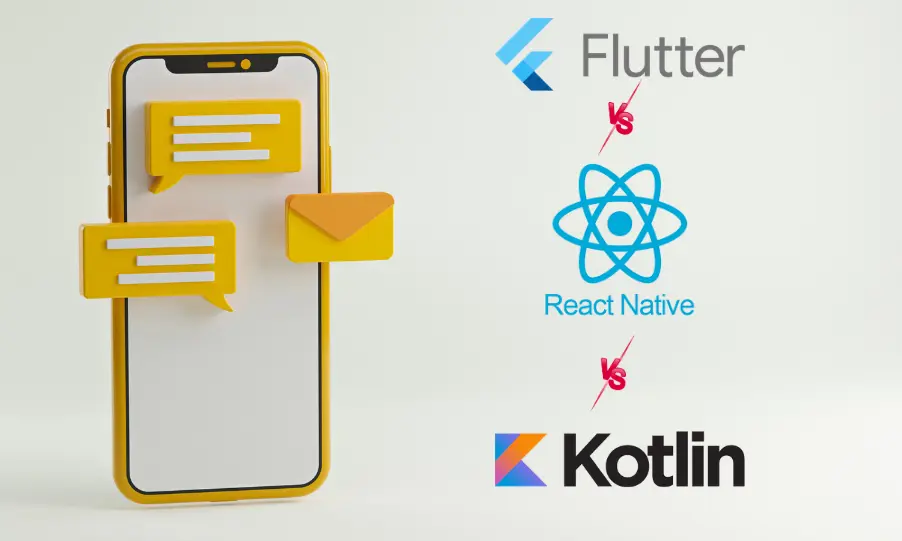
Choosing the right enterprise mobile app tech stack in 2026 is one of the most important strategic decisions for businesses building scalable digital products. When evaluating Flutter vs React Native vs Kotlin Multiplatform, companies must consider factors like performance, scalability, developer productivity, ecosystem support, and long-term maintenance. The technology stack you choose directly impacts app performance, scalability, maintenance cost, security, development speed, and long-term business growth.
Today’s enterprise apps are no longer simple mobile applications. They are connected ecosystems that integrate AI, cloud computing, APIs, analytics, IoT, ERP systems, and real-time collaboration tools. Because of this, selecting the wrong stack can lead to technical debt, slow performance, higher operational costs, and future scalability problems.
This guide explains how to choose the best tech stack for enterprise mobile app development in 2026, including detailed comparisons of Flutter, React Native, and Kotlin Multiplatform, backend technologies, architecture patterns, databases, cloud infrastructure, and security strategies.
Best Enterprise Mobile App Tech Stacks in 2026
- Flutter – Best for fast cross-platform development and UI-heavy apps
- React Native – Best for rapid deployment and JavaScript ecosystems
- Kotlin Multiplatform – Best for large-scale enterprise-grade apps
- Node.js – Ideal backend for real-time systems
- Spring Boot (Java) – Best for enterprise scalability and security
- Microservices + Cloud-native architecture – Recommended for enterprise apps
What is an Enterprise Mobile App Tech Stack?
An enterprise mobile app tech stack is the combination of technologies used to build, deploy, manage, and scale a mobile application for business operations.
A modern enterprise stack includes:
| Layer | Components |
|---|---|
| Frontend | Mobile frameworks, UI technologies |
| Backend | APIs, databases, business logic |
| Infrastructure | Cloud hosting, DevOps, CI/CD |
| Security | Authentication, encryption, compliance |
| Integrations | ERP, CRM, payment systems, analytics |
The tech stack acts as the foundation of the entire application ecosystem.
Before selecting frameworks and backend technologies, businesses should first understand the complete enterprise mobile app development guide, including architecture planning, scalability, integrations, and deployment strategies.
Why Choosing the Right Tech Stack Matters
Many businesses focus only on development cost or launch speed. However, enterprise applications are long-term investments that must support:
- Millions of users
- Continuous updates
- Complex integrations
- High-level security
- AI and analytics workloads
- Global scalability
A poorly selected stack can create major issues later:
- Slow app performance
- High infrastructure costs
- Difficult maintenance
- Security vulnerabilities
- Poor developer productivity
In contrast, the right stack improves:
- Time-to-market
- User experience
- System reliability
- Scalability
- Long-term ROI
Core Components of an Enterprise Mobile App Tech Stack
1. Frontend Layer (Mobile App)
This is the user-facing part of the application.
It includes:
- Mobile frameworks
- UI rendering systems
- Programming languages
- Native device integrations
The frontend directly affects:
- Performance
- User experience
- Responsiveness
- Offline functionality
2. Backend Layer
The backend powers:
- APIs
- Authentication
- Databases
- Business workflows
- Notifications
- Analytics
A scalable backend is critical for enterprise applications because mobile apps often process large amounts of real-time data.
3. Infrastructure & Cloud
Modern enterprise apps rely heavily on cloud-native infrastructure for:
- Auto-scaling
- High availability
- Disaster recovery
- DevOps automation
Cloud architecture is now essential rather than optional.
Flutter vs React Native vs Kotlin Multiplatform (2026 Comparison)
The biggest decision in enterprise mobile development is choosing the frontend framework.
Here’s a detailed comparison.
| Feature | Flutter | React Native | Kotlin Multiplatform |
|---|---|---|---|
| Language | Dart | JavaScript | Kotlin |
| Performance | Near-native | Moderate | Native-level |
| Code Sharing | 90%+ | 80–90% | 60–80% |
| UI Flexibility | Excellent | Good | Native UI |
| Scalability | High | Medium | Very High |
| Community | Strong | Massive | Growing |
| Enterprise Readiness | High | Medium | Excellent |
| Best Use Cases | UI-heavy apps | Fast MVPs | Large enterprise systems |
Deep Dive: Flutter for Enterprise Apps
What is Flutter?
Flutter is Google’s cross-platform UI framework that allows developers to build Android, iOS, desktop, and web apps using a single codebase.
Flutter has become one of the fastest-growing enterprise mobile technologies because of its performance and design flexibility.
Advantages of Flutter
1. Near-Native Performance
Flutter uses its own rendering engine, enabling smooth animations and responsive UI performance.
This is especially useful for:
- Enterprise dashboards
- Logistics systems
- Healthcare interfaces
- Fintech applications
2. Faster Development
A single codebase significantly reduces:
- Development time
- Maintenance effort
- QA complexity
This lowers overall project costs.
3. Consistent User Experience
Flutter provides pixel-perfect UI consistency across devices.
This matters for enterprises that need:
- Brand consistency
- Standardized interfaces
- Multi-device support
Limitations of Flutter
- Larger app sizes
- Smaller talent pool compared to JavaScript
- Some advanced native integrations may require platform-specific code
Best Use Cases for Flutter
Flutter is ideal for:
- Startup MVPs
- Retail applications
- Employee management apps
- Logistics apps
- UI-intensive enterprise platforms
Deep Dive: React Native
What is React Native?
React Native, created by Meta, enables developers to build mobile apps using JavaScript and React.
It remains popular because many businesses already have JavaScript development teams.
Strengths of React Native
1. Rapid Development
React Native allows quick prototyping and deployment.
This is ideal for:
- Startups
- Time-sensitive launches
- Iterative product development
2. Huge Ecosystem
React Native benefits from:
- Large community support
- Thousands of third-party packages
- Easy hiring availability
3. Web + Mobile Synergy
Companies with existing React web apps can reuse logic and resources.
This reduces operational complexity.
Weaknesses of React Native
- Performance limitations for graphics-heavy apps
- Dependency on third-party libraries
- Native bridge bottlenecks in complex systems
Best Use Cases
React Native works best for:
- Moderate-complexity apps
- Internal enterprise tools
- Retail apps
- Social platforms
- Customer engagement applications
Deep Dive: Kotlin Multiplatform (KMP)
What is Kotlin Multiplatform?
Kotlin Multiplatform allows developers to share business logic across Android and iOS while maintaining native UI.
Unlike Flutter or React Native, KMP prioritizes native performance.
Advantages of Kotlin Multiplatform
1. Native-Level Performance
KMP provides better performance than traditional cross-platform frameworks.
This is essential for:
- Banking apps
- Trading platforms
- Healthcare systems
- Enterprise security applications
2. Better Scalability
Large organizations prefer KMP because it integrates smoothly with enterprise-grade native ecosystems.
3. Long-Term Maintainability
Kotlin is now heavily supported by Google and enterprise engineering teams.
Limitations of KMP
- Smaller ecosystem
- Higher learning curve
- Requires experienced developers
Best Use Cases
KMP is best for:
- Enterprise banking systems
- High-security applications
- Large enterprise ecosystems
- Performance-critical platforms
Native vs Cross-Platform Development
One of the biggest debates in 2026 remains:
Should enterprises build native apps or cross-platform apps?
| Criteria | Native Apps | Cross-Platform Apps |
|---|---|---|
| Performance | Highest | High |
| Development Cost | Higher | Lower |
| Maintenance | Complex | Easier |
| Time-to-Market | Slower | Faster |
| Scalability | Excellent | Good to Excellent |
Recommendation:
Choose Native/Kotlin Multiplatform if:
- Performance is mission-critical
- Security is a top concern
- The app handles complex workflows
Choose Flutter/React Native if:
- Speed matters
- Budget is limited
- Cross-platform consistency is required
Backend Technology Selection
Frontend frameworks alone are not enough.
Enterprise apps require powerful backend systems.
Best Backend Technologies in 2026
| Technology | Best For |
|---|---|
| Node.js | Real-time systems |
| Spring Boot (Java) | Enterprise-grade scalability |
| .NET Core | Microsoft ecosystems |
| Django / FastAPI | AI-powered apps |
Node.js
Best for:
- Chat systems
- Real-time collaboration
- Logistics tracking
Advantages:
- Fast API responses
- Excellent scalability
- Event-driven architecture
Spring Boot (Java)
Still one of the strongest enterprise backend technologies.
Best for:
- Banking
- Insurance
- Healthcare
- Large enterprise systems
Advantages:
- Security
- Stability
- Enterprise integration support
Python (FastAPI/Django)
Python dominates AI-driven enterprise apps.
Ideal for:
- AI integration
- Predictive analytics
- Automation systems
Database Selection: SQL vs NoSQL
Choosing the wrong database architecture can create scaling issues later.
SQL Databases
Examples:
- PostgreSQL
- MySQL
- Microsoft SQL Server
Best for:
- Financial systems
- Structured business data
- ERP systems
Advantages:
- Strong consistency
- ACID compliance
- Reliable transactions
NoSQL Databases
Examples:
- MongoDB
- Firebase
- Cassandra
Best for:
- Real-time apps
- High-volume scalable systems
- Flexible data structures
Cloud Infrastructure Choices
Enterprise apps in 2026 are increasingly cloud-native.
Top Cloud Platforms:
Amazon Web Services (AWS)
Best for:
- Scalability
- Enterprise infrastructure
- AI integrations
Microsoft Azure
Best for:
- Microsoft-based ecosystems
- Enterprise IT infrastructure
Google Cloud Platform (GCP)
Best for:
- AI and machine learning
- Data analytics workloads
Recommended Enterprise Architecture in 2026
1. Monolithic Architecture
Advantages:
- Simple setup
- Faster initial development
Disadvantages:
- Hard to scale
- Difficult maintenance
2. Microservices Architecture
Modern enterprises increasingly prefer microservices.
Benefits:
- Independent deployment
- Better scalability
- Faster updates
- Fault isolation
Microservices are ideal for:
- Enterprise SaaS products
- Fintech systems
- Logistics platforms
3. Serverless Architecture
Benefits:
- Auto-scaling
- Reduced infrastructure management
- Cost efficiency
Best for:
- Event-driven systems
- Notification services
- AI workflows
API Strategy for Enterprise Apps
APIs are the backbone of enterprise ecosystems.
REST APIs
Best for:
- Standard enterprise integrations
- Stable systems
Advantages:
- Simplicity
- Wide adoption
GraphQL
Best for:
- Dynamic frontend applications
- Flexible data fetching
Advantages:
- Reduced API calls
- Better performance for mobile apps
DevOps & CI/CD for Enterprise Apps
Modern mobile development requires automation.
Popular DevOps Tools
- Jenkins
- GitHub Actions
- Docker
- Kubernetes
- Terraform
Benefits of DevOps Integration
- Faster deployments
- Continuous delivery
- Reduced human errors
- Improved scalability
Enterprises using mature DevOps pipelines release updates significantly faster than traditional teams.
Security Considerations in Enterprise Mobile Apps
Security is one of the most critical factors in enterprise app development.
Essential Security Practices
Different frameworks have unique vulnerabilities and architectural limitations. Understanding security considerations by framework helps enterprises choose technologies that align with compliance and data protection requirements.
1. End-to-End Encryption
Protects sensitive user and business data.
2. Multi-Factor Authentication (MFA)
Essential for enterprise-grade access control.
3. Secure API Gateways
Prevents unauthorized access.
4. Compliance Readiness
Support:
- GDPR
- HIPAA
- SOC 2
- ISO 27001
Cost Impact of Tech Stack Choices
Frontend frameworks, backend technologies, and cloud infrastructure directly influence scalability, maintenance effort, and overall budgets. Learn more about how tech stack affects development cost in enterprise mobile applications.
| Stack Decision | Cost Impact |
|---|---|
| Native Development | Higher |
| Cross-platform Development | Moderate |
| Microservices Architecture | Higher initial cost |
| Serverless Infrastructure | Lower long-term cost |
Best Tech Stack by Industry
| Industry | Recommended Stack |
|---|---|
| Healthcare | Kotlin + Java + AWS |
| Finance | Kotlin + Spring Boot |
| Logistics | Flutter + Node.js |
| Retail | React Native + Firebase |
| SaaS Platforms | Flutter + FastAPI |
| AI Products | Flutter + Python + GCP |
Best Practices for Choosing the Right Tech Stack
Align Technology with Business Goals
Do not choose technologies based only on trends.
Choose based on:
- Product goals
- User scale
- Future roadmap
Prioritize Scalability Early
Many apps fail because scalability is treated as an afterthought.
Design for growth from day one.
Avoid Over-Engineering
Complex architecture increases:
- Cost
- Development time
- Maintenance effort
Start simple and evolve strategically.
Evaluate Long-Term Maintenance
Consider:
- Talent availability
- Community support
- Upgrade cycles
- Vendor lock-in risks
Decision Framework (Quick Guide)
Choose Flutter If:
- You need fast development
- UI consistency matters
- Budget efficiency is important
Choose React Native If:
- Your team already uses JavaScript
- You want rapid deployment
- App complexity is moderate
Choose Kotlin Multiplatform If:
- You need native-level performance
- Security is critical
- You’re building a large enterprise ecosystem
FAQs
What is the best tech stack for enterprise mobile apps?
The best stack depends on your business goals. Flutter and Kotlin Multiplatform are among the top enterprise choices in 2026.
Is Flutter better than React Native?
Flutter offers better UI performance and consistency, while React Native enables faster development using JavaScript ecosystems.
What backend is best for enterprise apps?
Spring Boot, Node.js, and .NET Core remain the most popular enterprise backend technologies.
What architecture is best for enterprise mobile apps?
Microservices architecture is considered the most scalable and flexible for modern enterprise systems.
Should enterprises choose cross-platform development?
Yes, cross-platform frameworks are excellent for reducing costs and speeding up development-unless extreme performance optimization is required.
Conclusion
Choosing the right enterprise mobile app tech stack in 2026 is no longer just a technical decision-it’s a business strategy decision.
The ideal approach combines:
- Flexible frontend technologies
- Scalable backend systems
- Cloud-native infrastructure
- Strong security architecture
- DevOps automation
There is no universal “best” stack. The right choice depends on your:
- Business goals
- Budget
- Scalability requirements
- Product complexity
- Time-to-market expectations
However, one thing is clear: businesses that invest in scalable architecture and future-ready technologies today will have a major competitive advantage tomorrow.
If you’re planning to build a modern enterprise mobile application, choosing the right technology foundation from the start can save years of redevelopment costs and scalability challenges.
Looking for scalable and future-ready mobile solutions? Our custom enterprise app development services help businesses build secure, high-performance applications tailored to complex operational requirements.
Author Bio
Pavans Group Team
Pavans Group is a top-rated software, web, mobile app, AI and IoT development company based in Vadodara, Gujarat. With 100+ apps delivered for clients including Amul, Indian Oil, and global startups, we help businesses build reliable, scalable digital products. Rated 4.9/5 on Clutch · 5.0/5 on GoodFirms.