






Patient portal development cost typically ranges from about $30,000 for a focused custom portal to $200,000+ for an advanced platform with EHR integration, mobile apps, telehealth, complex permissions and enterprise requirements. The final budget depends less on the number of screens and more on integrations, patient-data security, user roles, interoperability, workflows, testing and the level of production reliability required. Current published 2026 cost guides show similarly wide ranges because the term “patient portal” can describe anything from a basic scheduling interface to a multi-site healthcare platform.
For healthcare organizations, clinics and health-tech founders, the better budgeting question is not simply:
How much does a patient portal cost?
It is:
What workflows must the portal support, which clinical systems must it connect to, what patient information will it handle, and what level of security and interoperability does the organization require?
This guide breaks those questions into a practical budget.
Patient Portal Development Cost at a Glance
| Patient portal scope | Typical functionality | Indicative planning range |
|---|---|---|
| Focused MVP | Login, profile, appointments, basic messaging, documents | $30,000–$60,000 |
| Integrated patient portal | MVP + EHR/EMR connection, test results, billing, forms, notifications | $60,000–$120,000 |
| Advanced patient engagement platform | Telehealth, prescriptions, care plans, multiple integrations, mobile access | $100,000–$180,000+ |
| Enterprise patient portal | Multi-location, multi-EHR, advanced permissions, SSO, mobile apps, analytics | $150,000–$200,000+ |
These figures are planning benchmarks, not Pavans Group quotations. Published 2026 guides differ materially depending on the scope and assumptions behind each estimate. Augere Labs
A portal with one appointment workflow and one clinical integration cannot be compared directly with an enterprise platform serving several facilities and synchronizing multiple clinical systems.
What Is a Patient Portal?
A patient portal is a secure digital application that allows patients to interact with healthcare services and access relevant health information online.
Depending on the organization, patients may be able to:
- create and manage an account;
- book or reschedule appointments;
- view test results;
- access medical documents;
- communicate securely with providers;
- request prescription renewals;
- complete intake forms;
- pay bills;
- join virtual consultations;
- view care plans;
- manage dependent or caregiver access.
The portal may be a web application, mobile application or both.
For healthcare organizations planning a broader digital platform, Pavans Group’s healthcare software development page covers patient portals alongside EHR/EMR, telemedicine, laboratory, mobile health and integration requirements.
Why Do Patient Portal Development Quotes Vary So Much?
Two portals can look very similar to patients while requiring dramatically different engineering effort behind the interface.
Consider these two examples.
Portal A
Patients can:
- register;
- book appointments;
- receive notifications;
- download uploaded reports.
The clinic manually manages parts of the workflow through an administrator dashboard.
Portal B
Patients can:
- authenticate through an identity provider;
- access health information from an EHR;
- view laboratory results;
- schedule appointments against live provider availability;
- request prescription refills;
- pay bills;
- join telehealth consultations;
- receive personalized reminders;
- manage family-member access.
The second portal introduces significantly more work involving integrations, permissions, data synchronization, security and testing.
That difference is why feature count alone is a weak way to estimate patient portal software.
Patient Portal Development Cost by Complexity
Basic Patient Portal or MVP
A focused MVP usually concentrates on one or two important patient journeys.
Possible scope:
- patient registration;
- secure authentication;
- profile management;
- appointment scheduling;
- basic messaging;
- document/report viewing;
- admin portal.
Indicative planning range: $30,000–$60,000
A portal at this level can be useful for validating a digital patient workflow without immediately building every healthcare feature.
The MVP should still be designed around the security and privacy obligations that apply to the organization. “MVP” should not mean postponing essential protection of patient information.
Mid-Level EHR-Integrated Patient Portal
A more mature portal may add:
- EHR/EMR integration;
- laboratory results;
- intake forms;
- billing;
- payment processing;
- appointment reminders;
- secure provider messaging;
- prescription-related workflows;
- patient documents;
- detailed role-based access.
Indicative planning range: $60,000–$120,000
Integration is often the major difference between this tier and a simpler portal.
Advanced Patient Engagement Platform
An advanced system can include:
- telehealth;
- care-plan tracking;
- digital intake;
- multiple clinical integrations;
- payment workflows;
- multilingual functionality;
- patient mobile applications;
- analytics;
- advanced notification workflows.
Indicative planning range: $100,000–$180,000+
At this stage, the product is becoming a wider patient-engagement platform rather than a simple portal.
Enterprise Patient Portal
Large healthcare organizations may require:
- multiple hospitals or facilities;
- several EHR systems;
- advanced identity management;
- single sign-on;
- caregiver/proxy access;
- complex permissions;
- auditability;
- enterprise reporting;
- high availability;
- iOS and Android applications;
- large-scale integration architecture.
Indicative planning range: $150,000–$200,000+
Some enterprise projects can exceed these ranges considerably when interoperability, migration, organizational rollout or legacy systems become complex. Current market guides show enterprise estimates extending substantially beyond $200,000 depending on scope. KrishaWeb
Patient Portal Development Cost Breakdown
The budget is usually distributed across several workstreams.
| Development area | What it includes | What increases cost |
|---|---|---|
| Discovery | Workflows, users, requirements, risks | Multiple departments and unclear processes |
| UI/UX | Patient journeys, prototypes, accessibility | Multiple personas and complex workflows |
| Frontend | Patient portal and admin interfaces | Web + mobile requirements |
| Backend | APIs, logic, workflows, data processing | Complex healthcare operations |
| Authentication | Login, MFA, identity, proxy access | Enterprise identity requirements |
| EHR/EMR integration | Patient records and clinical data | Legacy systems and bidirectional sync |
| Other integrations | Labs, billing, pharmacy, telehealth | Number and quality of external APIs |
| Security | Access controls, auditability, secure architecture | Sensitive data and regulatory scope |
| QA | Functional, integration, security and workflow testing | Large workflow combinations |
| Deployment | Environments, monitoring, backups | Enterprise availability requirements |
| Support | Updates, incidents and improvements | Number of integrations and release frequency |
An estimate that shows these components is more useful than a single number with no assumptions.
Features That Affect Patient Portal Development Cost
Patient Registration and Authentication
A basic portal might use email and password authentication.
More complex requirements can include:
- multi-factor authentication;
- identity verification;
- SSO;
- caregiver access;
- parent/guardian access;
- organization-level identity systems.
The more sensitive the data and actions, the more carefully identity and permissions need to be designed.
Appointment Scheduling
Simple appointment requests are relatively straightforward.
Real-time scheduling can involve:
- provider calendars;
- appointment types;
- locations;
- availability;
- cancellations;
- rescheduling;
- reminders;
- waiting lists.
If the scheduling information comes from another healthcare system, integration becomes part of the feature.
Medical Records and Test Results
Patients may need access to:
- laboratory reports;
- visit summaries;
- prescriptions;
- medical documents;
- diagnostic history.
The complexity depends on where this information lives and how it becomes available to the portal.
A file manually uploaded by an administrator is a simpler implementation than real-time synchronization with a clinical system.
Secure Messaging
Messaging can involve:
- patient-provider communication;
- support teams;
- attachments;
- notifications;
- read status;
- message history.
The workflow should also define what patients should do in urgent situations rather than unintentionally positioning portal messaging as emergency communication.
Billing and Payments
Patient billing may require:
- invoice display;
- online payment;
- payment status;
- receipts;
- refunds;
- billing-system integration.
More sophisticated healthcare billing can introduce much more complexity than a conventional payment gateway.
Digital Forms
Digital forms can replace manual intake and consent workflows.
Features may include:
- conditional questions;
- electronic signatures;
- document uploads;
- saved progress;
- form versioning;
- routing to administrative teams.
Telehealth
Telehealth can add:
- video consultations;
- provider availability;
- virtual waiting rooms;
- appointment integration;
- secure session access;
- post-consultation workflows.
The cost depends on whether video infrastructure is built, integrated or provided by a third-party service.
Mobile Patient App
A mobile application adds another product surface that must be designed, developed and tested.
Features can include:
- appointment management;
- push notifications;
- reports;
- messaging;
- telehealth;
- biometric login.
If mobile access is central to the patient experience, Pavans Group’s mobile app development services can form part of the broader healthcare platform architecture.
EHR and EMR Integration: One of the Largest Cost Drivers
For many patient portals, the difficult work is not the interface.
It is getting reliable healthcare data into and out of the portal.
The system may need to exchange:
- patient demographics;
- appointments;
- encounters;
- results;
- clinical documents;
- medication information;
- care plans.
Integration complexity depends on:
- EHR vendor;
- API availability;
- FHIR support;
- HL7 interfaces;
- authentication;
- data ownership;
- synchronization direction;
- write-back requirements.
Read-only vs bidirectional integration
A portal that only displays information is generally simpler than a portal that can modify clinical-system data.
For example:
EHR → Portal
Display upcoming appointments.
is simpler than:
Portal ↔ EHR
Book, reschedule and cancel appointments in both systems.
Bidirectional synchronization introduces conflict resolution and failure recovery.
Modern API vs legacy integration
A modern API with reliable documentation can reduce uncertainty.
Legacy systems may require:
- middleware;
- HL7 interfaces;
- file exchange;
- custom mapping;
- scheduled synchronization.
That difference alone can materially change the development budget.
HIPAA and Patient Portal Development Cost
For U.S. healthcare use cases, teams often discuss whether a patient portal must support HIPAA requirements.
The correct scope depends on the organization, data and relationships involved. HIPAA obligations should be evaluated with qualified legal/compliance professionals rather than assumed from a feature checklist.
The U.S. Department of Health and Human Services states that regulated entities must implement appropriate administrative, physical and technical safeguards to protect electronic protected health information, including access controls, audit controls, authentication and transmission security. HHS.gov
Official reference:https://www.hhs.gov/hipaa/for-professionals/security/laws-regulations/index.html
From a software-development perspective, relevant requirements may affect:
- authentication;
- authorization;
- audit logging;
- secure transmission;
- data storage;
- session handling;
- backups;
- incident response;
- vendor selection.
Compliance should therefore be considered during architecture and planning rather than added immediately before launch.
For a broader discussion of healthcare software security and privacy requirements, see our healthcare app development compliance guide.
Patient Portal Cost by Platform
Web-Based Patient Portal
A responsive web portal is often the most cost-efficient starting point.
It can support desktop, tablet and mobile browsers without maintaining separate native applications.
Patient Portal + Cross-Platform Mobile App
Adding a cross-platform app introduces:
- mobile UX;
- app authentication;
- notifications;
- app-store releases;
- mobile testing.
Patient Portal + Native iOS and Android
Separate native applications can require greater implementation and maintenance effort.
Native development may be justified when the product depends heavily on platform-specific capabilities, but it should not be chosen only because native technology sounds more sophisticated.
Patient Portal Development Cost by Region
Development location can affect labor cost, but country-level averages are a poor substitute for evaluating an actual team.
A healthcare software quotation depends on:
- team composition;
- seniority;
- architecture;
- UX;
- integration complexity;
- QA;
- security;
- project management.
A lower hourly rate does not necessarily mean a lower final budget.
For example:
Team A: $30/hour × 4,000 hours = $120,000
Team B: $55/hour × 1,800 hours = $99,000
The higher hourly rate produces the lower project cost because fewer hours are required.
When comparing providers in India, the USA, UK or elsewhere, normalize the complete scope rather than comparing hourly rates alone.
Patient Portal MVP: What Should Be Included?
A useful MVP should complete a meaningful patient journey.
For example:
Register → Authenticate → Find appointment → Book → Receive confirmation → View appointment
or:
Register → Authenticate → View test result → Download report
A reasonable MVP might include:
- patient registration;
- secure login;
- profile;
- appointment workflow;
- document/result access;
- notifications;
- basic administrative tools;
- monitoring and backups.
Features that can often wait
Depending on the business model:
- AI assistant;
- advanced analytics;
- wearable integration;
- complex care plans;
- several EHR integrations;
- extensive personalization;
- native mobile applications.
Do not defer features that are necessary for safe operation or applicable privacy/security requirements.
How Long Does Patient Portal Development Take?
A development timeline should be based on scope rather than a generic number.
Published 2026 guides commonly place focused patient portal implementations in the range of a few months, while advanced and enterprise systems can require substantially longer.
A typical project includes:
Discovery
Define:
- users;
- workflows;
- integrations;
- compliance scope;
- MVP.
UX Design
Prototype important journeys such as:
- registration;
- scheduling;
- results;
- billing.
Architecture
Define:
- data model;
- authentication;
- integrations;
- permissions;
- infrastructure.
Development
Build the portal incrementally.
Integration
Connect clinical and administrative systems.
Testing
Test:
- permissions;
- workflows;
- integrations;
- failure conditions;
- accessibility;
- relevant security requirements.
Deployment
Configure production environments, monitoring and backups.
Pilot and Rollout
A controlled pilot can reveal workflow problems before organization-wide adoption.
Hidden and Ongoing Patient Portal Costs
Development cost is only part of the ownership budget.
Possible ongoing expenses include:
- cloud hosting;
- monitoring;
- backups;
- email/SMS notifications;
- telehealth provider fees;
- payment-processing fees;
- EHR/API charges;
- security updates;
- support;
- penetration testing where required;
- product enhancements.
Patient Portal Maintenance Cost
Maintenance may include:
- bug fixes;
- dependency updates;
- security patches;
- API changes;
- infrastructure;
- monitoring;
- performance work.
Third-party healthcare systems also evolve.
An EHR or API provider may:
- change an endpoint;
- update authentication;
- introduce a new API version;
- deprecate older functionality.
Integration maintenance should therefore be part of the operating plan.
How to Calculate First-Year Patient Portal Cost
A more useful budget formula is:
First-Year Patient Portal Cost = Initial Development + 12 × Monthly Operating Costs + Security/Compliance Costs + Support + Planned Enhancements
Consider a hypothetical example:
Initial development: $75,000
Infrastructure and services: $1,500/month
Annual support/security budget: $18,000
Planned enhancements: $20,000
Calculation:
$75,000 + ($1,500 × 12) + $18,000 + $20,000 = $131,000
This is an illustrative calculation, not a Pavans Group quotation or market average.
Its purpose is to demonstrate why procurement teams should compare total cost of ownership, not only development quotations.
Custom Patient Portal vs EHR Vendor Portal
Custom development is not always the right decision.
Many EHR products already include patient-facing capabilities.
Use an existing portal when:
- the workflow is standard;
- the existing portal supports required patient functions;
- branding/customization is not important;
- integrations already work;
- additional software ownership would create little value.
Consider custom development when:
- patient workflows are highly specialized;
- several systems must be combined;
- the portal is itself part of a health-tech product;
- existing software creates significant operational workarounds;
- custom patient experience is strategically important.
A useful decision sequence is:
Use existing → Configure/extend → Integrate → Build custom
rather than assuming custom development is automatically superior.
Example: What Healthcare Platform Experience Teaches About Portal Scope
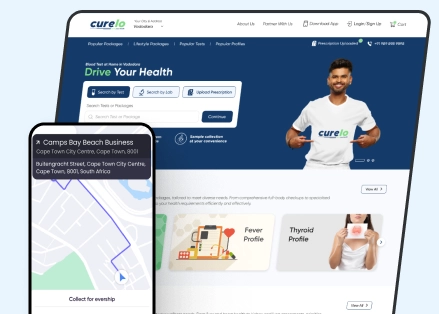
Pavans Group’s Curelo healthcare platform case study provides a useful example of why healthcare software can extend beyond one patient-facing interface.
The documented platform includes:
- patient web and mobile experiences;
- diagnostic-test search;
- online booking;
- payments;
- digital reports;
- phlebotomist workflows;
- laboratory portal;
- role-based access;
- real-time booking management.
Curelo should not be treated as a conventional hospital patient portal or as a pricing benchmark.
The relevant lesson is architectural: a patient-facing experience often depends on operational workflows behind it.
A feature such as:
“View diagnostic report”
may require:
Lab uploads report → booking/test mapping → permissions → secure storage → patient access
The visible patient feature is only the final part of the workflow.
How to Reduce Patient Portal Development Cost
Start with the highest-value patient journey
Do not begin with every possible healthcare feature.
Identify the workflow that creates the most value.
Validate integrations early
If the project depends on an EHR, laboratory or billing system, confirm the integration path before building large amounts of surrounding functionality.
Use existing healthcare standards where appropriate
Avoid inventing proprietary structures where established interoperability approaches already meet the requirement.
Avoid unnecessary platforms in version one
If a responsive web application adequately validates the product, mobile apps can sometimes follow later.
Reuse mature services
Identity, payments, messaging and video infrastructure do not always need to be built from scratch.
Do not cut security to reduce cost
Reducing necessary authentication, authorization, testing or monitoring can create significantly larger problems later.
Separate MVP from roadmap
Define:
Must launch
versus:
Useful later
and protect that distinction during development.
How to Choose a Patient Portal Development Company
Healthcare buyers should evaluate more than frontend design skills.
Healthcare workflow understanding
Can the team explain how the patient-facing workflow connects to clinical and operational processes?
Integration capability
Ask about experience with:
- APIs;
- FHIR/HL7 where relevant;
- EHR/EMR integration;
- laboratories;
- payments;
- identity systems.
Security approach
Ask how:
- patient access is controlled;
- permissions are enforced;
- sensitive data is protected;
- activity is logged.
QA process
Healthcare workflows should be tested beyond the successful path.
Ask how the team tests:
- unavailable integrations;
- invalid patient data;
- permission errors;
- duplicate events;
- failed payments;
- interrupted workflows.
UX capability
Patients can include users with very different:
- ages;
- technical comfort;
- devices;
- accessibility needs.
A technically correct portal can still fail if patients cannot use it confidently.
Ownership
Clarify ownership of:
- source code;
- infrastructure;
- design files;
- vendor accounts;
- credentials;
- documentation.
Post-launch support
Ask who handles:
- production incidents;
- updates;
- API changes;
- security patches;
- enhancements.
Questions to Answer Before Requesting a Patient Portal Quote
Prepare the following information.
Who will use the portal?
Patients only?
Caregivers?
Providers?
Administrative staff?
Which workflows are required?
Appointments, records, messaging, payments, telehealth or something else?
Which healthcare systems already exist?
List:
- EHR/EMR;
- laboratory system;
- billing platform;
- scheduling system;
- pharmacy integrations.
Does the portal need to modify external records?
Read-only access is different from bidirectional workflows.
Do you need mobile applications?
Web only or web + mobile?
Which markets will the system serve?
Privacy and regulatory requirements vary by jurisdiction.
What volume do you expect?
Consider:
- patients;
- appointments;
- documents;
- locations;
- messages.
Is data migration required?
If replacing an existing portal, determine what historical information needs to move.
What belongs in the first release?
Define MVP separately from future functionality.
Frequently Asked Questions
How much does patient portal development cost?
A custom patient portal can cost approximately $30,000 to $200,000+, depending on features, EHR integrations, security requirements, mobile applications and enterprise complexity. A focused MVP sits toward the lower end, while multi-system enterprise portals can exceed the upper range.
What is the biggest factor affecting patient portal development cost?
EHR/EMR and other healthcare integrations are often among the largest variables because they introduce data mapping, synchronization, authentication, testing and failure handling in addition to the visible patient interface.
How much does an EHR-integrated patient portal cost?
A portal with meaningful EHR integration will generally cost more than a standalone appointment or document portal. A practical planning range for a moderately integrated custom portal is roughly $60,000–$120,000, while deeper enterprise integration can move considerably higher.
How much does a patient portal MVP cost?
A focused custom MVP can start around $30,000–$60,000 depending on the workflows, integrations, design, security and deployment requirements.
Does HIPAA compliance increase patient portal development cost?
Security and compliance requirements can increase engineering, documentation, testing and operational effort. The actual impact depends on the organization, data, architecture and applicable requirements; there is no universal “HIPAA surcharge.”
How long does patient portal development take?
A focused portal may take a few months, while integrated or enterprise platforms can take substantially longer. The timeline should be determined after reviewing requirements, clinical-system dependencies and rollout plans.
Should we build a custom portal or use our EHR’s portal?
Use the existing portal when it adequately supports your patient workflows. Custom development becomes more compelling when you need differentiated workflows, deeper integrations, a branded digital-health product or functionality your current EHR portal cannot reasonably provide.
Can a patient portal include a mobile app?
Yes. Patient portals can be web-based, mobile-based or both. Adding iOS and Android applications increases design, development, testing and long-term maintenance requirements.
What ongoing costs should we budget for?
Plan for infrastructure, monitoring, notifications, third-party services, integration maintenance, security updates, technical support and future enhancements.
What information is needed for an accurate quote?
Provide the desired patient workflows, EHR/EMR details, integrations, platforms, user roles, expected patient volume, regulatory markets, security requirements, migration needs and MVP scope.
Conclusion
Patient portal development cost is driven primarily by the workflow behind the interface.
A focused patient portal can begin around $30,000–$60,000, while integrated patient-engagement platforms may require $60,000–$180,000+ and enterprise implementations can move beyond $200,000 depending on clinical integrations and organizational complexity.
The most important cost drivers are:
- EHR/EMR integration;
- patient workflows;
- user roles;
- authentication;
- privacy and security;
- web/mobile scope;
- telehealth;
- billing;
- clinical data exchange;
- testing;
- production support.
Before requesting a quote, define the core patient journey and identify every system that participates in it.
That gives a development team something far more useful than a generic request to “build a patient portal.”
If you are evaluating a custom healthcare platform, you can discuss your healthcare software requirements with Pavans Group using your workflows, integrations and expected launch scope as the starting point.
Author Bio
Naresh Chauhan – CEO, Pavans Group
Naresh Chauhan is the CEO of Pavans Group, an IT and software development company that helps founders turn ideas into AI-powered products and helps enterprises turn manual workflows into automated systems across web, mobile, SaaS and IoT. Connect with him on LinkedIn or visit pavansgroup.com.